











SEO for technology companies is about attracting potential customers who need your software, products, or services—not simply increasing website traffic. A SaaS startup may want more product trials, while a software development company needs qualified project enquiries. Both require an organic search strategy built around buyer intent, useful content, and technical website performance.
Technology buyers rarely make decisions after reading one page. A startup founder may research software development costs, while a CTO evaluates system architecture, security, and integrations. Their searches are different, even when both are considering the same solution.
An effective technology SEO strategy connects these searches with information that helps people understand problems, compare options, and evaluate providers.
This guide explains how US-based SaaS startups, software companies, and B2B technology businesses can improve organic visibility, create helpful content, and measure results beyond keyword rankings.
What Is SEO for Technology Companies?
SEO for technology companies is the process of improving a technology business’s visibility in relevant organic search results.
It combines keyword research, on-page optimization, technical SEO, content planning, internal linking, and performance measurement.
For example, someone searching for “custom software development process” is probably researching how software gets built. Another person searching for “custom software development company” may be evaluating providers.
Both searches relate to software development, but they represent different needs.
The first is suitable for an educational article. The second typically belongs on a commercial service page.
The purpose of technology SEO is to connect each search with the most useful page while supporting meaningful business outcomes.
Why SEO for Technology Companies Requires a Different Approach
Technology products often have complex features, specialized terminology, and longer purchasing journeys.
Unlike a simple retail purchase, choosing business software may involve several stakeholders.
| Buyer | Main Concern | Useful Content |
|---|---|---|
| Startup Founder | Cost, launch planning, growth | Planning and pricing guides |
| CTO | Architecture, scalability, security | Technical explanations |
| Product Manager | Features and implementation | Comparison articles |
| IT Manager | Compatibility and maintenance | Integration documentation |
| Business Owner | Return on investment and suitability | Solution and service pages |
Different stakeholders may research the same product from different perspectives.
Complex Technology Needs Clear Explanations
Terms such as API integration, cloud infrastructure, BLE connectivity, and application architecture may be familiar to engineers.
Business buyers may need to understand what these technologies actually do, when they matter, and which limitations affect implementation.
Useful SEO content explains these relationships without oversimplifying important technical details.
Qualified Leads Matter More Than Traffic Volume
A programming tutorial might receive thousands of visits from students and developers.
A specific article comparing software development approaches may attract fewer visitors but more relevant business decision-makers.
Both types of content can be useful. However, businesses should prioritize topics according to their actual goals.
1. Understand Your Buyers Before Researching Keywords
A successful B2B SEO strategy starts with understanding the people who influence purchasing decisions.
For software businesses, these may include founders, technical leaders, product teams, and operations managers.
Each audience searches differently.
A founder might ask:
“How much does it cost to build a SaaS application?”
A technical lead might search:
“How should we design a scalable SaaS architecture?”
Both questions concern the same broad topic, but their answers require different detail.
Build buyer profiles around four questions:
- What problem is the buyer trying to solve?
- What information is needed before choosing a solution?
- Is the buyer learning, comparing options, or evaluating providers?
- Which website page can best answer the search?
Where available, use real sales conversations, support questions, customer enquiries, and Search Console data.
These sources can help identify search language that generic keyword research tools may overlook.
2. How to Build an SEO Strategy for Technology Companies
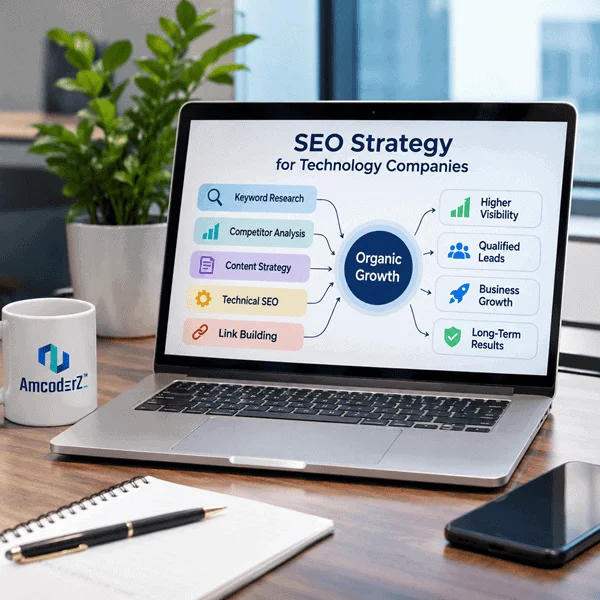
Keyword research should focus on search intent, relevance, and business value—not just monthly search volume.
A broad keyword may generate more searches, but a specific query can indicate a more relevant potential customer.
Understand the Four Types of Search Intent
| Intent | Example Search | Suitable Page |
|---|---|---|
| Informational | What is custom software development? | Educational blog |
| Commercial research | Custom software vs SaaS | Comparison guide |
| Commercial | Custom software development company | Service page |
| Navigational | Specific software company name | Company homepage |
These examples illustrate intent categories. Actual search results should be reviewed before choosing a target page.
Create a Keyword-to-Page Map
Imagine a company offering custom software and SaaS development.
A practical content structure might look like this:
| Website Page | Main Keyword Theme | Reader’s Goal |
|---|---|---|
| Service page | Custom software development services | Find a provider |
| Educational guide | Software development process | Understand implementation |
| Comparison article | Custom software vs off-the-shelf software | Compare options |
| Technical article | SaaS application architecture | Evaluate technologies |
| Cost guide | Custom software development cost | Understand budgeting |
This approach makes it easier to create distinct pages without repeating the same information.
Select Primary and Supporting Keywords Naturally
Choose one main search intent for each article.
Supporting keywords should describe related subtopics rather than appear repeatedly in every paragraph.
For example, an article about technology SEO can naturally discuss on-page optimization, technical SEO, SaaS SEO strategy, and B2B lead generation.
There is no need to repeat the exact primary keyword in every heading.
Avoid Keyword Cannibalization
Keyword cannibalization can become a concern when multiple pages target nearly identical searches without offering distinct value.
Before publishing a new article, check whether an existing page already answers the topic.
If so, improving that page may be more useful than publishing another similar URL.
3. Technical SEO for Technology Websites
Technical SEO helps search engines access, render, and understand important website content.
Software companies often use JavaScript frameworks, dynamic navigation, application interfaces, and complex website structures.
These technologies can work well with search engines, but the implementation needs to be checked.
Review Crawlability and Indexing
Start with important technical checks:
- Accidental
noindexdirectives. - Robots.txt restrictions.
- Canonical URL configuration.
- Broken internal links.
- Redirect chains.
- XML sitemap accuracy.
- Server errors.
- Mobile usability.
For example, if a website uses both www.example.com and example.com, it should communicate its preferred version consistently.
However, multiple URLs appearing in Search Console do not automatically indicate a duplicate-content problem.
Verify Google’s selected canonical before changing redirects or canonical tags.
Google’s SEO Starter Guide provides foundational advice on website structure and content discovery.
Make JavaScript Content Accessible
Many technology websites rely on React, Vue, and similar frameworks.
JavaScript itself does not prevent a website from ranking.
Problems can occur when essential content, headings, or navigation links are unavailable during rendering.
Review whether search engines can reliably access important page information.
Depending on the application, server-side rendering or static generation may be appropriate.
Improve Page Experience
Slow pages can frustrate visitors, particularly on mobile connections.
Review loading performance, responsiveness, and layout stability using relevant real-user data.
Common optimization opportunities include image compression, unnecessary scripts, and inefficient resource loading.
Prioritize improvements that genuinely affect visitors rather than chasing an arbitrary test score.
4. Create Content That Solves Technology Buyers’ Problems
Content marketing becomes more effective when every article answers a meaningful question.
Generic topics such as “Benefits of Technology” often lack a clear audience.
A more useful article might be:
“Custom Software vs SaaS: Which Is Better for Your Business?”
That topic allows readers to compare important factors.
Custom software may offer greater control over integrations and workflows, but it requires development, testing, and maintenance.
An existing SaaS product may be faster to adopt, although customization and integration options may be limited.
Explaining these trade-offs is more helpful than claiming one solution is always best.
Use Practical Technical Examples
Consider a hypothetical healthcare startup building a wearable-connected mobile application.
Its team might need to evaluate:
- Bluetooth communication requirements.
- Mobile operating system restrictions.
- Data synchronization.
- Security and privacy considerations.
- Cloud integration.
- Long-term application maintenance.
A useful article explains how these factors influence development decisions.
This is an illustrative scenario, not a claim about a completed client project.
Add Genuine Experience Where Available
A real case study can make technology content more valuable.
For example, an approved software project write-up might explain the original challenge, technical requirements, implementation approach, and verified outcomes.
Businesses can also publish original diagrams, testing observations, and technical decision frameworks.
Avoid inventing customer results, statistics, or development experiences.
Google’s people-first content guidance emphasizes originality, reliable information, and meaningful reader value.
5. Build Topic Clusters and Improve Internal Linking
A topic cluster connects a broad educational resource with supporting articles that answer more specific questions.
For a software development company, a central guide might explain custom software development.
Supporting articles could cover architecture, APIs, project planning, testing, and maintenance.
Each article should address a distinct need.
A reader exploring software architecture may benefit from learning more about custom software development services and how business requirements influence implementation.
Similarly, an article explaining website performance may naturally reference professional SEO services when readers are considering outside support.
The goal is to help visitors move between related information.
Internal links should guide readers, not simply increase keyword frequency.
Use descriptive anchor text, avoid unnecessary repetition, and link to relevant destinations.
6. Make Technology SEO Content Clear for AI Search and LLMs
Technology buyers increasingly use traditional search results alongside AI-assisted search tools.
This makes clear definitions, accurate technical explanations, and credible references valuable.
However, AI search visibility does not require abandoning established SEO practices.
Google’s AI features guidance explains that foundational search optimization principles remain relevant.
Answer Important Questions Directly
If a heading asks, “What is technical SEO?” begin with a short definition before expanding into details.
This makes information easier for readers to understand.
Explain Technical Relationships
A guide about IoT development should distinguish between devices, communication protocols, mobile applications, and cloud services.
Explain how these components interact and where limitations apply.
Clear explanations are more useful than repeatedly inserting related keyword variations.
Use Reliable References
Support technical statements with official documentation and credible sources.
Identify assumptions where appropriate.
Do not invent industry statistics or claim guaranteed visibility in AI Overviews, ChatGPT, or other AI-generated answers.
LLM-friendly content should first be accurate, understandable, and useful to people.
7. Measure Organic Traffic and Qualified B2B Leads
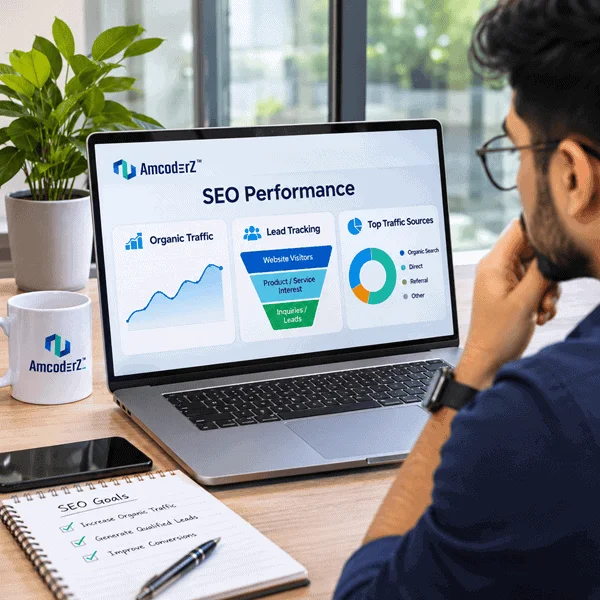
SEO performance should be evaluated through relevant search visibility and meaningful business outcomes.
Google Search Console provides information about clicks, impressions, click-through rate, average position, and search queries.
Analytics and CRM tools can help connect organic visits with enquiries and sales opportunities.
Why Impressions Can Increase While Clicks Decline
Consider this hypothetical example:
| Metric | Previous Period | Recent Period |
|---|---|---|
| Impressions | 1,000 | 2,000 |
| Clicks | 100 | 40 |
| CTR | 10% | 2% |
Impressions doubled, but clicks declined.
Possible causes include new low-ranking queries, changes in branded search demand, and differences in search-result behavior.
This does not automatically prove an algorithm penalty.
The correct approach is to compare relevant queries, landing pages, countries, and devices over equivalent periods.
Measure Business Outcomes
Important technology SEO KPIs include:
- Non-branded organic clicks.
- Relevant landing-page visits.
- Demo requests.
- Consultation enquiries.
- Qualified form submissions.
- Leads progressing into sales opportunities.
A page generating a small number of qualified enquiries may be more valuable than one attracting large volumes of unrelated traffic.
8. Practical Technology SEO Checklist
Before expanding your website’s content library, review the essentials.
| SEO Area | Recommended Check |
|---|---|
| Keyword strategy | Match search intent to the correct page |
| On-page SEO | Use clear titles, headings, and helpful content |
| Technical SEO | Check crawlability, indexing, and canonical URLs |
| JavaScript | Confirm important content renders reliably |
| Internal links | Connect related articles and service pages |
| Content quality | Include original explanations and practical examples |
| E-E-A-T | Support claims with real evidence and credible sources |
| Conversion tracking | Measure relevant enquiries, not just visits |
Not every website needs the same changes.
Prioritize confirmed problems affecting important pages before making broad revisions.
9. A 90-Day SEO Roadmap for Technology Companies
A structured plan helps technology businesses allocate resources more effectively.
Days 1–30: Research and Audit
Review Search Console performance, current landing pages, technical issues, and existing content.
Identify high-priority queries based on search intent and business relevance.
Create a keyword-to-page map.
Check for overlapping articles before publishing new content.
Days 31–60: Improve Important Pages
Resolve confirmed indexing and technical problems.
Strengthen commercial service pages with accurate explanations, relevant internal links, and clear contact options.
Improve existing informational content through practical examples and better structure.
Add verified technical insights where possible.
Days 61–90: Expand and Measure
Publish supporting articles where research identifies useful content gaps.
Connect related pages naturally.
Measure changes in search visibility, non-branded clicks, engagement, and qualified enquiries.
A 90-day plan is an implementation framework, not a guarantee of first-page rankings.
Frequently Asked Questions About SEO for Technology Companies
What is SEO for technology companies?
SEO for technology companies improves organic search visibility for software, SaaS, IT, and other technology businesses through keyword research, technical optimization, useful content, and performance measurement.
How is technology SEO different from general SEO?
Technology SEO often involves complex products, specialized search queries, multiple decision-makers, and longer purchasing journeys.
What should SaaS startups prioritize in SEO?
Start with accessible product pages, buyer-focused keyword research, useful comparison content, internal linking, and conversion measurement.
Can SEO generate qualified leads for software companies?
Yes. Relevant organic searches can connect potential customers with helpful information and appropriate commercial pages.
Does AI search optimization replace traditional SEO?
No. Technical accessibility, useful content, accurate information, and established SEO practices remain important.
About AmcoderZ Infotech
AmcoderZ Infotech is a software development and digital services company based in Ahmedabad, Gujarat, India.
The company provides mobile app development, web development, custom software solutions, healthcare software development, and SEO services.
Through its Organic SEO Services, AmcoderZ supports businesses with keyword research, technical SEO, on-page optimization, content planning, and search performance analysis.
Location: Ahmedabad, Gujarat, India.
Website: https://amcoderz.com/
Conclusion
Effective SEO for technology companies starts with understanding what customers need and creating useful information around those needs.
Technical optimization makes important pages accessible. Keyword research connects content with search intent. Internal linking supports navigation, while performance measurement helps businesses understand whether their visibility contributes to meaningful outcomes.
For SaaS startups, software providers, and B2B technology businesses, the goal should be sustainable growth in relevant search traffic and qualified enquiries.
If your technology business needs help evaluating search visibility and identifying improvement opportunities, explore AmcoderZ’s SEO services to learn more about its approach to organic growth.
