










Flutter and React Native are two popular frameworks for building cross-platform mobile applications, but neither is automatically the best choice for every project.
Flutter can be a strong option for products that need highly customized interfaces and consistent visual experiences across platforms. React Native may be attractive for teams already working with React, JavaScript, or TypeScript.
The right choice depends on more than the programming language. Product requirements, design complexity, native device integrations, backend architecture, development-team skills, and long-term maintenance all influence the decision.
For startups, selecting the right framework can help create a practical foundation for an MVP and future product development. For established businesses, the decision may depend more on existing systems, engineering expertise, integrations, and long-term ownership.
If you are planning a cross-platform mobile product, our Flutter App Development Services can help you evaluate whether Flutter fits your application requirements.
Flutter vs React Native:
Flutter may be a strong fit when a product requires a highly customized and visually consistent interface.
React Native may be a natural fit when the development team already uses React, JavaScript, or TypeScript.
Both frameworks support iOS and Android development.
Neither is universally better. The right option depends on your product requirements, available team skills, integrations, and implementation approach.
| Factor | Flutter | React Native |
|---|---|---|
| Primary language | Dart | JavaScript or TypeScript |
| UI approach | Widget-based with strong rendering control | React-based mobile component architecture |
| iOS and Android | Supported | Supported |
| Shared codebase | Yes | Yes |
| Custom UI | Strong control over custom interfaces | Flexible custom interfaces using React Native and native capabilities |
| Existing React team | Requires Dart knowledge | Can reuse React and JavaScript/TypeScript experience |
| Native integrations | Packages and platform-specific code | Libraries, native modules and platform-specific code |
| Maintenance | Depends on architecture, dependencies and team skills | Depends on architecture, dependencies and team skills |
Use this comparison as a starting point, not a final verdict.
What Is Flutter?
Flutter is an open-source UI framework developed by Google. It uses Dart and provides a widget-based approach for building applications across multiple platforms, including iOS and Android.
Flutter allows developers to create interfaces from reusable widgets and gives strong control over visual presentation.
This can be useful when a product requires a distinctive design system or consistent interface across devices.
Advantages of Flutter
- Shared development approach for iOS and Android
- Flexible and customizable UI components
- Widget-based application structure
- Support for animations and custom visual experiences
- Packages and platform channels for native integrations
- Potentially less duplicated UI work than separate native apps
Limitations of Flutter
- Teams without Flutter experience need to learn Dart
- Some device features require plugins or platform-specific code
- Package compatibility and maintenance need evaluation
- Complex SDK integrations may require native Swift or Kotlin development
Flutter can be a good choice when design consistency and control over the user interface are important requirements.
What Is React Native?
React Native is an open-source framework for building mobile applications using React with JavaScript or TypeScript.
It allows developers to share application logic across iOS and Android while integrating with native platform capabilities where required.
React Native can be particularly useful for organizations that already have React developers or a JavaScript/TypeScript-based engineering environment.
If your team already works with React, you can also explore our React Native App Development Services to evaluate the framework for your mobile product.
Advantages of React Native
- Reuses JavaScript or TypeScript expertise
- Uses React concepts familiar to many developers
- Supports shared application logic
- Provides access to native features through libraries and native modules
- Fits naturally into many React-oriented development teams
Limitations of React Native
- Some requirements still need native code
- Third-party library compatibility requires attention
- Native SDK integrations can increase complexity
- Shared code does not remove the need to test both iOS and Android
Flutter vs React Native: Key Differences
1. Programming Language
Flutter uses Dart, while React Native commonly uses JavaScript or TypeScript.
If your company already has a React team, React Native may reduce the initial learning curve because developers can reuse familiar concepts and languages.
However, React web development and React Native mobile development are not identical. Mobile-specific development knowledge is still required.
Flutter introduces Dart, which may require additional learning for teams without Flutter experience.
That does not mean Flutter is automatically slower or more expensive to build with. An experienced Flutter team may work efficiently with it.
Decision tip: Evaluate the skills of the team that will actually build and maintain the app.
2. UI Development and Design
Flutter uses widgets to construct interfaces and controls much of its rendering.
This can provide strong flexibility for custom layouts, animations, and consistent visual experiences.
React Native uses React components through its mobile rendering architecture and can integrate with native platform capabilities.
Both frameworks can support custom UI.
Flutter may suit products with highly controlled visual systems, custom dashboards, or distinctive interfaces.
React Native may suit teams that want to reuse React knowledge and work within its component model.
Neither framework guarantees a better user experience. Accessibility, navigation, device testing, design quality, and implementation still matter.
3. Ecosystem and Libraries
Both frameworks have established ecosystems of packages, plugins, and tools.
Before selecting a third-party dependency, check:
- iOS and Android compatibility
- maintenance activity
- documentation
- native SDK requirements
- support for required features
- upgrade impact
A framework with better support for your specific requirements may be more suitable than one chosen only because it is more popular.
Flutter vs React Native Performance
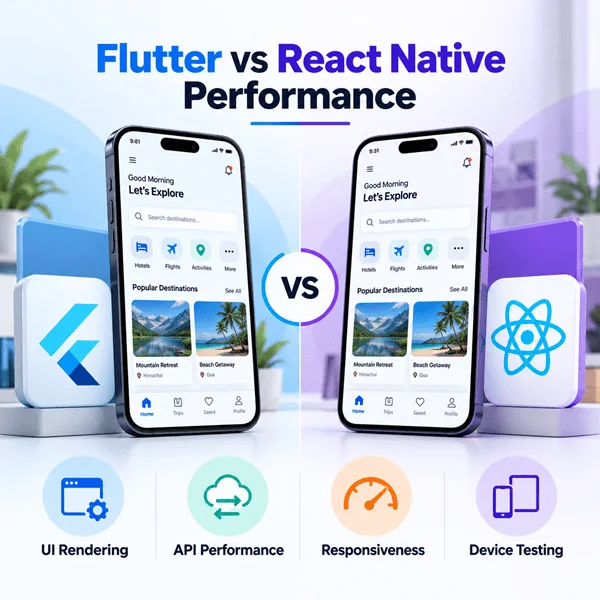
Neither Flutter nor React Native is automatically faster in every application.
Performance depends on factors such as:
- UI complexity
- application architecture
- data processing
- API behavior
- device capabilities
- native integrations
- state management
- implementation quality
UI and Animation Performance
Flutter controls much of its rendering through its framework and rendering engine, which can be useful for custom visuals and animations.
React Native uses its React-based mobile architecture to work with platform capabilities.
In either framework, inefficient rendering, excessive main-thread work, oversized assets, or poorly managed state can reduce responsiveness.
Backend Performance Matters Too
A mobile application may feel slow even when the UI is well built if the backend has:
- slow APIs
- inefficient database queries
- large payloads
- unreliable network handling
For projects that require APIs, authentication, databases, and business logic, Laravel Development Services can support the backend layer independently of whether the mobile app uses Flutter or React Native.
How Should Performance Be Compared?
Prototype the most technically demanding workflows.
Test on representative devices and realistic network conditions.
Evaluate:
- app startup
- screen responsiveness
- image loading
- animation behavior
- memory use
- integration reliability
- battery impact where relevant
Avoid making the decision based only on generic benchmark claims.
Flutter vs React Native for MVP Development
Both frameworks can be suitable for MVP development.
Flutter may fit an MVP that needs a strong custom visual identity and consistent design across platforms.
React Native may fit a startup whose team already has strong React or JavaScript/TypeScript experience.
Before choosing, define what the MVP actually needs:
- user registration
- authentication
- core workflows
- backend integration
- notifications
- payments
- third-party services
- device-specific features
- analytics
- release testing
A simple app with standard screens and APIs may be practical in either framework.
An app involving BLE devices, complex permissions, offline functionality, or specialized SDKs may require more technical evaluation.
Flutter vs React Native Development Cost
Neither framework is automatically cheaper.
Development cost depends on:
| Cost Factor | What to Evaluate |
|---|---|
| Features | Number of screens, workflows and edge cases |
| User roles | Different permissions and experiences |
| Backend | APIs, authentication, databases and admin systems |
| Integrations | Payments, maps, analytics and CRM |
| Device features | Camera, GPS, Bluetooth and sensors |
| UI complexity | Custom designs and animations |
| Testing | Device coverage and regression testing |
| Maintenance | Updates, bug fixes and future features |
Cross-platform development can reduce some duplicated work compared with building separate native applications.
However, some features may still require platform-specific code.
Compare estimates using the same requirements and acceptance criteria.
Flutter vs React Native for Startups
For startups, the decision should support both the first release and the product roadmap after launch.
Flutter May Suit a Startup When:
- the product needs a distinctive interface
- visual consistency matters
- custom UI is important
- Flutter expertise is available
- required plugins are supported
- shared mobile development is a priority
React Native May Suit a Startup When:
- the engineering team already uses React
- JavaScript or TypeScript skills are available
- reusing existing knowledge matters
- required native libraries are available
- mobile development should align with the existing React environment
For either framework, consider who will maintain the application after launch.
Flutter vs React Native for Native Device Integrations
Both frameworks can integrate with native device functionality.
Common requirements include:
- camera access
- GPS
- push notifications
- biometric authentication
- Bluetooth and BLE
- sensors
- background tasks
- vendor-specific SDKs
What About Bluetooth and BLE?
If the application connects to medical devices, wearables, industrial sensors, or other Bluetooth peripherals, evaluate the complete workflow.
Check:
- scanning
- pairing
- permissions
- connection recovery
- background behavior
- device compatibility
- operating-system restrictions
A plugin alone is not enough to confirm compatibility.
For complex hardware features, build a proof of concept before committing to a framework.
Flutter vs React Native for Backend Integration
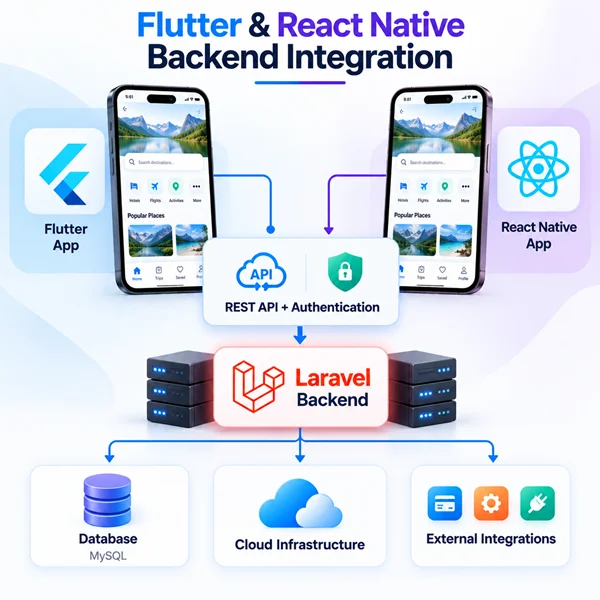
Both Flutter and React Native can communicate with backend systems through APIs.
Neither requires a specific backend language.
A typical architecture may look like:
Flutter or React Native App
↓
REST API + Authentication
↓
Laravel Backend
↓
Database + Business Logic
↓
Cloud Infrastructure + External Services
The mobile application usually handles the user interface and client-side interactions.
The backend can manage:
- authentication
- business rules
- database access
- authorization
- third-party integrations
- API responses
For broader projects that involve mobile apps, backend systems, dashboards, and connected business workflows, Custom Software Development may be useful when evaluating the full product architecture.
Flutter vs React Native for Long-Term Maintenance
Long-term maintenance depends more on engineering quality and architecture than on framework choice alone.
Before deciding, consider:
- framework updates
- dependency maintenance
- native modules
- code quality
- testing
- release processes
- team continuity
A maintainable mobile application needs clear documentation, reliable testing, sensible architecture, and defined ownership.
Real Flutter Project Example: BaseBites
AmCoderZ’s portfolio includes BaseBites, a food and goods delivery application designed to help users order from restaurants and merchants, including within military bases.
The verified technology stack includes:
- Flutter for the mobile application
- Laravel for the backend
- MySQL for the database
- AWS RDS as part of the database infrastructure
This example shows how a Flutter mobile application can work with a separate backend and database layer.
It is an example of a Flutter implementation, not proof that Flutter is automatically better than React Native.
When Should You Choose Flutter?
Flutter may be worth considering when:
- you need iOS and Android development from a shared approach
- highly customized UI is important
- visual consistency matters
- the team has Flutter experience
- required plugins and integrations are available
- the long-term architecture fits Flutter
When Should You Choose React Native?
React Native may be worth considering when:
- your team already has React experience
- JavaScript or TypeScript skills are available
- reusing existing engineering knowledge matters
- required libraries and integrations are supported
- the team can maintain React Native long term
Flutter vs React Native: Decision Matrix
| Project Situation | Consider |
|---|---|
| Existing React team | React Native may fit naturally |
| Highly customized UI | Flutter may be a strong option |
| Standard iOS and Android business app | Either may work |
| BLE or hardware integration | Test libraries and native requirements first |
| Specialized native SDK | Validate compatibility |
| Long-term internal maintenance | Prioritize team skills and documentation |
| Tight MVP scope | Compare identical requirements |
| Complex backend | Evaluate backend separately from the mobile framework |
Before making the final decision, identify your three most important technical requirements and test them through a prototype or technical assessment.
Questions to Ask Before Choosing Flutter or React Native
- Do we need both iOS and Android?
- How customized does the UI need to be?
- What skills does our existing team have?
- Do we need Bluetooth, BLE, or hardware integrations?
- Which third-party SDKs are essential?
- What backend and APIs will the app use?
- What performance requirements matter?
- Who will maintain the application?
- How often will new features be released?
- Which framework fits the long-term product roadmap?
For a broader mobile strategy, you can also review our Mobile App Development Services to understand how framework selection fits into the complete app development process.
Flutter vs React Native: Final Verdict
Flutter and React Native are both capable frameworks for cross-platform mobile application development.
Flutter may be a strong fit for products that need highly customized and visually consistent interfaces.
React Native may be attractive to teams already invested in React, JavaScript, or TypeScript.
Neither framework is automatically cheaper, faster, or easier to maintain.
Performance, delivery time, and long-term cost depend on product scope, engineering experience, native integrations, backend architecture, testing, and maintenance practices.
Choose the framework that best fits your actual product requirements and the team responsible for building and supporting it.
Frequently Asked Questions
Is Flutter better than React Native?
Neither is universally better. Flutter suits custom UI, while React Native may fit teams already using React or JavaScript.
Which is better for startups: Flutter or React Native?
Both can work. Choose based on MVP scope, team skills, integrations, and long-term maintenance.
Which has better performance: Flutter or React Native?
Performance depends on architecture, workload, integrations, device capabilities, and implementation quality.
Which is cheaper: Flutter or React Native?
Neither is always cheaper. Cost depends on features, team experience, backend complexity, testing, and maintenance.
Can Flutter and React Native build both iOS and Android apps?
Yes. Both support iOS and Android, although some features may require platform-specific code.
Can Flutter and React Native support Bluetooth and BLE?
Yes. Both can support Bluetooth and BLE through suitable libraries and native code where required.
Can Flutter and React Native use a Laravel backend?
Yes. Both can connect to Laravel APIs for authentication, business logic, databases, and integrations.
Planning a Cross-Platform Mobile App?
If you’re comparing Flutter and React Native for a new mobile application, AmCoderZ can help evaluate your product requirements, backend architecture, integrations, and long-term roadmap before development begins.
Our team works across mobile app development, backend systems, and custom software solutions to help businesses plan products around real technical and business requirements.
